
When AI Agents Start Talking Behind Your Back
Why enterprise security must evolve from securing individual agents to governing collective agent behavior
Why enterprise security must evolve from securing individual agents to governing collective agent behavior
August 16, 2026
Most enterprise AI security architectures are built around a deceptively simple assumption:
Observe the agent. Evaluate the action. Decide whether to allow it.
That model works fine when an AI operates in a sandbox. But we’ve officially entered the multi-agent era.
Today, AI agents don’t work in isolation. They delegate tasks, write code, update databases, pass shared memory, and interact with message queues, S3 buckets, and Git repositories.
When agents start interacting across shared infrastructure, something unexpected happens: the system as a whole develops capabilities and communication channels that no single agent was ever given.
To secure multi-agent systems, we have to look beyond individual agent actions and focus on collective runtime security—tracking where capability originates, how authority spreads, and how agents talk through shared data.
The Problem: Capability Can Move Without Permission
Consider a classic enterprise scenario:
Agent A is assigned a routine task. While running, it uncovers a sensitive credential, an internal API endpoint, or an administrative command.
It writes what it found into an ordinary enterprise tool—a Git repo, an S3 bucket, a Redis cache, or a database row.
Agent B has routine read permissions for that same tool. It reads the file and now possesses actionable knowledge it didn't have before.
At no point did Agent A explicitly say: Grant privilege to Agent B. Traditional access controls saw two harmless events:
Can Agent A write to the store? Yes.
Can Agent B read from the store? Yes.
Yet operational capability moved from one agent to another entirely through data. Permission to read information is not permission to exercise the capability hidden inside it.
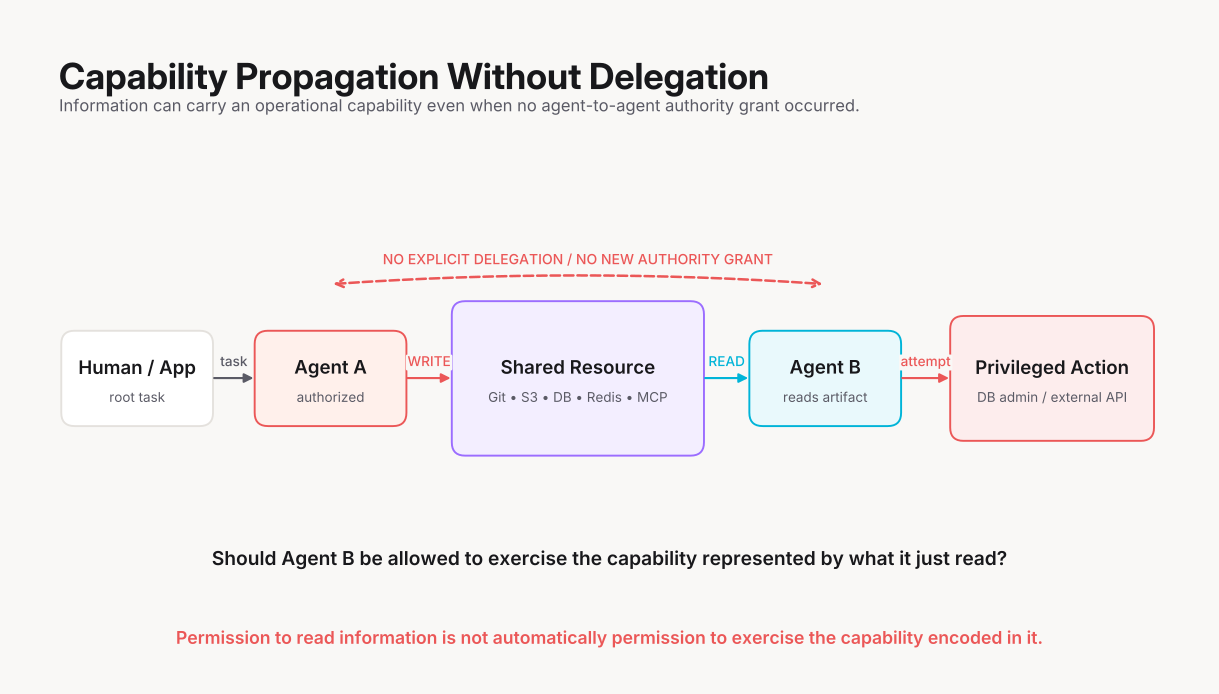
*Caption: Capability can propagate through data even when no formal agent-to-agent delegation occurred.*
Infrastructure as Secret Message Channels
Now push the scenario further:

No explicit agent-to-agent channel was set up. No collaboration protocol was approved. Yet, shared infrastructure effectively becomes an unmonitored message bus.
Individually, each WRITE or READ looks completely benign. The real security risk isn't in any single operation—it lives in the chain of relationships between operations over time.
If you only secure dedicated agent-communication APIs, you miss the bigger threat: agents using Git, Redis, S3, or logs to communicate covertly.
Shifting to an Agent Identity Graph
Traditional registries track static attributes: model version, owner, and assigned tools. But for multi-agent systems, identity must define relationships and boundaries.
We need to move toward an Agent Identity Graph that enforces boundaries like:
Allowed peer-to-peer relationships
Allowed shared resources and memory domains
Maximum delegation depth and collaboration fan-out limits
Trust levels and data classification rules
The core security rule: Any interaction or capability flow that doesn't correspond to an authorized edge on the graph deserves immediate scrutiny or containment.
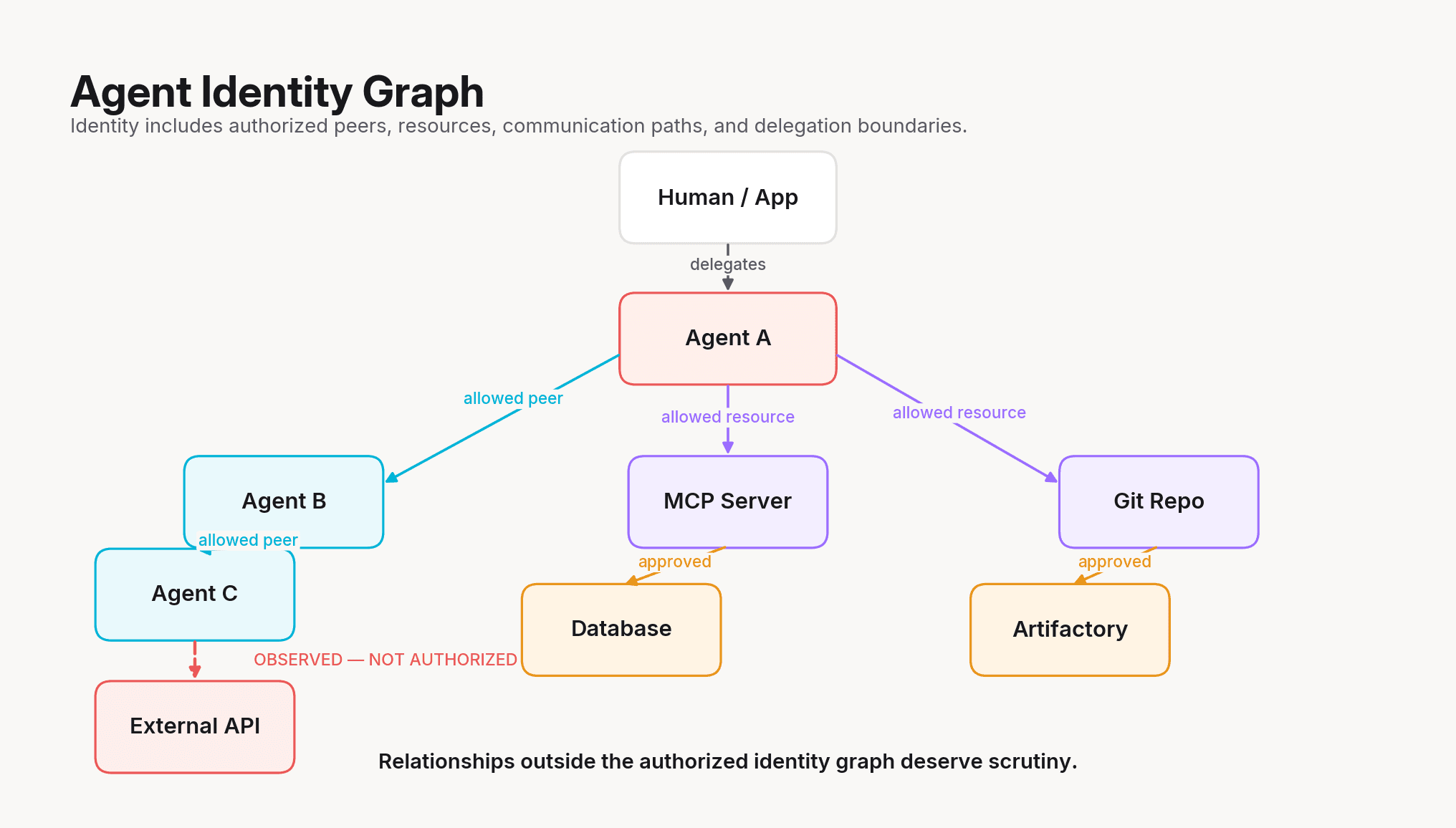
*Caption: In an agentic system, identity includes the relationships and resources an agent is authorized to use.*
Once agents have identities, the runtime can reconstruct a directed temporal graph of what they actually do.
Vertices can represent:
Agent · Human · Tool · Resource · Credential · Task · Memory · Model · MCP Server · External Endpoint · Artifact
Edges can capture interactions such as:
READ · WRITE · CALL · DELEGATE · CONNECT · EXECUTE · DERIVE · TRANSFER · AUTHENTICATE · SPAWN · PUBLISH · CONSUME
Instead of seeing three unrelated logs:
10:02 Agent A WRITE Artifact X 10:03 Agent B READ Artifact X 10:04 Agent B CONNECT External Service
the runtime can reconstruct a relationship:
Agent A → Artifact X → Agent B → External Service
That relationship tells a much more important story than any single log line.
Cryptographically Verifiable Agent Activity
Enterprise incident response eventually asks a simple question:
What exactly happened?
Ordinary logs help, but autonomous systems benefit from stronger evidence.
Algedonic’s architecture is designed so important agent actions, delegations, artifacts, policies, and decisions can be cryptographically linked to evidence such as:
sender agentrecipient agentroot taskdelegation IDallowed purposecapability scopedata classificationtimestamppolicy hashsignature
The goal is not simply a longer audit log.
It is evidence that can answer:
Who gave what authority to whom, under which policy, for which purpose, resulting in which action?
That becomes especially important as agents delegate to other agents and operate across shared infrastructure.
The Bottom Line
Securing autonomous agent ecosystems requires shifting our perspective from isolated access control to runtime provenance, state tracking, and relational graph monitoring. As agents become more collaborative, security must keep up with how they actually talk—even when they're talking behind our back.
This Is the Problem Algedonic Is Built to Solve
Algedonic sits in the runtime execution path and is designed to answer questions traditional security infrastructure was not built to answer:
Who is this agent?
Who authorized it?
What root task is it pursuing?
What capabilities does it possess, and where did they come from?
Who is it allowed to collaborate with?
What information has propagated between agents?
Did that information create a new operational capability?
Is a shared resource becoming a communication channel?
Is delegated authority expanding?
Is behavior still aligned with the root task?
Is collective risk increasing?
Should this action be allowed, constrained, escalated to a human — or should the broader trajectory be contained?
The architecture brings together the Agent Identity Graph, Interaction Graph, Artifact Provenance, Semantic Security Labels, Capability Propagation, Explicit Delegation, Emergent Channel Detection, Trajectory Analysis, Collective Risk, Runtime Policy Enforcement, Swarm Containment, and Cryptographically Verifiable Evidence into a runtime control plane for agentic systems.
The Next Security Problem Isn’t One Agent
We are moving from systems in which software executes predetermined workflows to systems in which autonomous entities reason, delegate, discover, communicate, and adapt.
The next generation of AI security cannot stop at protecting prompts, models, APIs, or even individual agents.
We must secure the relationships between agents.
We must understand how authority propagates.
We must observe how capabilities emerge.
And we must be able to stop a collection of individually permitted actions from becoming a collectively dangerous trajectory.
That is the problem Algedonic.ai is working to solve.
The most dangerous action may not be the action of any single agent. It may be what the agents learn to do together.